What forest school actually means
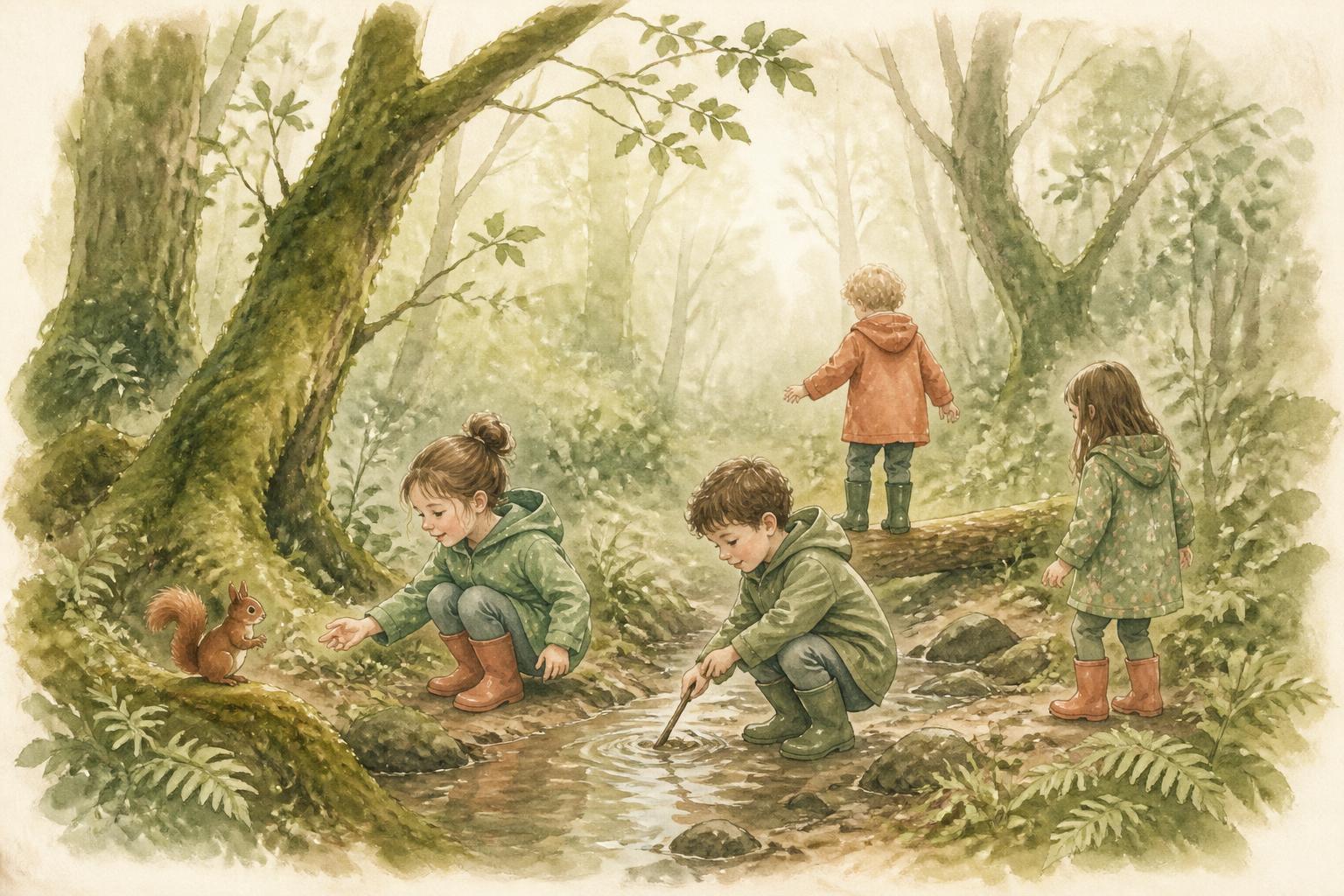
Forest school is a regular, repeated experience in the same outdoor place, over time, where children lead the learning and adults support rather than instruct. The repetition matters as much as the trees: children build relationship with a place, and confidence follows.
Sessions typically include free exploration, tool or fire work with older children where appropriate, den building, natural crafts, and a lot of unstructured time. Risk is managed, not removed — children are supported to take sensible, age-appropriate risks with supervision.
In Ireland it runs in a range of forms: standalone forest school providers, woodland preschools, nature-based summer camps, and mainstream settings that build regular woodland or garden sessions into the week.
Why outdoor learning does so much for young children
Outdoors, the environment changes constantly, which means the play does too. Uneven ground builds balance and core strength. Loose natural materials — sticks, stones, leaves, water — are open-ended, so children have to bring their own ideas.
It is also regulating. Wide-open space, natural light, movement and lower noise levels help many children settle in a way that no indoor calm corner can match.
In Irish settings, outdoor learning maps neatly onto Aistear's themes of Well-being and Exploring and Thinking, and Síolta's standard on the physical environment. It is curriculum, not a break from it.
Infographic
Build a forest school habit in six weeks
No woodland required — a park corner, a hedge and a repeated visit will do.
Week 1 — Choose one place
The same park corner or tree every week. Familiarity is the whole point.
Week 2 — Bring almost nothing
A bag, rope, magnifier, flask. Fewer props means richer play.
Week 3 — Follow, don't lead
Twenty minutes at one puddle counts as a full session.
Week 4 — Add one skill
Knot tying, den building, or safe use of one simple tool with supervision.
Week 5 — Notice and record
A photo and one sentence: what they tried, what they figured out.
Week 6 — Go in the rain
Waterproofs and spare socks solve most Irish weather. Rain is a texture.
Check the site for litter, agree a visible boundary, supervise water play, and wash hands afterwards.
Finding forest school in Ireland
Ask locally first: many county childcare committees, libraries and Coillte or council-run woodland sites list nature programmes, and some preschools run their own woodland mornings.
Questions worth asking any provider: how often do children return to the same site, what is the adult-to-child ratio, how is risk assessed, what happens in bad weather, and what insurance and vetting are in place.
Costs vary widely by county and format, so compare per-session cost against session length and group size rather than headline price.
Forest school at home, in Irish weather
Pick one place and return to it weekly — the same corner of a park, the same tree, the same patch of hedge. Familiarity is what turns a walk into forest school.
Bring almost nothing. A bag, a length of rope, a magnifier and a flask is plenty. The fewer things you bring, the more they use what is there.
Let them lead and resist narrating. Follow their pace even when it means twenty minutes at one puddle.
Waterproofs and spare socks solve about 80% of Irish weather problems. Rain is a texture, not a cancellation.
Safety basics: check the site for sharp litter, agree a boundary they can see, wash hands afterwards, and keep water play supervised.
Where our workshops fit
Our outdoor learning session covers how to run repeatable nature sessions in the space you actually have — a small yard, a green area, a local park — and how to document the learning for Aistear without adding paperwork.
For parents, the same ideas run through our nature-based play sessions, with a booklet of activities that need almost no equipment.
Frequently asked questions
- What is forest school?
- Forest school is a long-term, child-led approach to learning outdoors, where the same group returns to the same natural place regularly and adults support exploration rather than direct it.
- Is forest school available in Ireland?
- Yes. Ireland has standalone forest school providers, nature-based preschools and camps, and mainstream early years settings that run regular woodland or garden sessions. Availability varies a lot by county.
- What age is forest school for?
- Programmes commonly run from toddler age upward, with activities matched to age. Tool and fire work, where offered, is normally reserved for older children with close supervision.
- What should children wear to forest school in Ireland?
- Full waterproofs, wellies or sturdy boots, layers, a hat and a full change of clothes including spare socks. Comfortable children stay outdoors far longer.
- How does outdoor learning fit with Aistear and Síolta?
- Outdoor learning supports Aistear's Well-being and Exploring and Thinking themes and Síolta's standards on environment and play. It is curriculum delivery, not time away from curriculum.
- Can I do forest school without a forest?
- Yes. Repetition matters more than the site. Returning weekly to the same park corner, green area or garden patch gives most of the same benefits.
Keep reading
- BlogThe ECCE scheme explained: free preschool in Ireland, in plain EnglishWhat the ECCE scheme is, what age your child needs to be, how many days it covers and how to apply — plus how to tell whether a preschool is a good fit.Explore
- BlogHow to handle toddler tantrums calmly (without giving in)When tantrums start, why they happen, what to do in the middle of one, and what actually reduces them over time — for 2, 3, 4 and 5 year olds.Explore
- BlogFine motor activities for toddlers using what's already in the pressTwelve no-cost fine motor activities that build the hand strength behind buttons, zips and, eventually, a pencil grip.Explore
- BookBook a workshopSee upcoming dates and book onlineExplore
- ContactAsk a questionSend Amy a message about your setting or familyExplore
Bring these ideas into practice
Book a workshop to explore this further with Amy.
Trusted early years resources
Every workshop is grounded in Irish early years frameworks and national guidance.
- Aistear: the Early Childhood Curriculum Framework (NCCA)
- Síolta: the National Quality Framework
- Children First national guidance (Tusla)
- First 5: Ireland's strategy for babies & young children
- Early Childhood Ireland
Workshop themes · Book a date · Counties we serve · Play & learning blog · FAQ · About Amy