
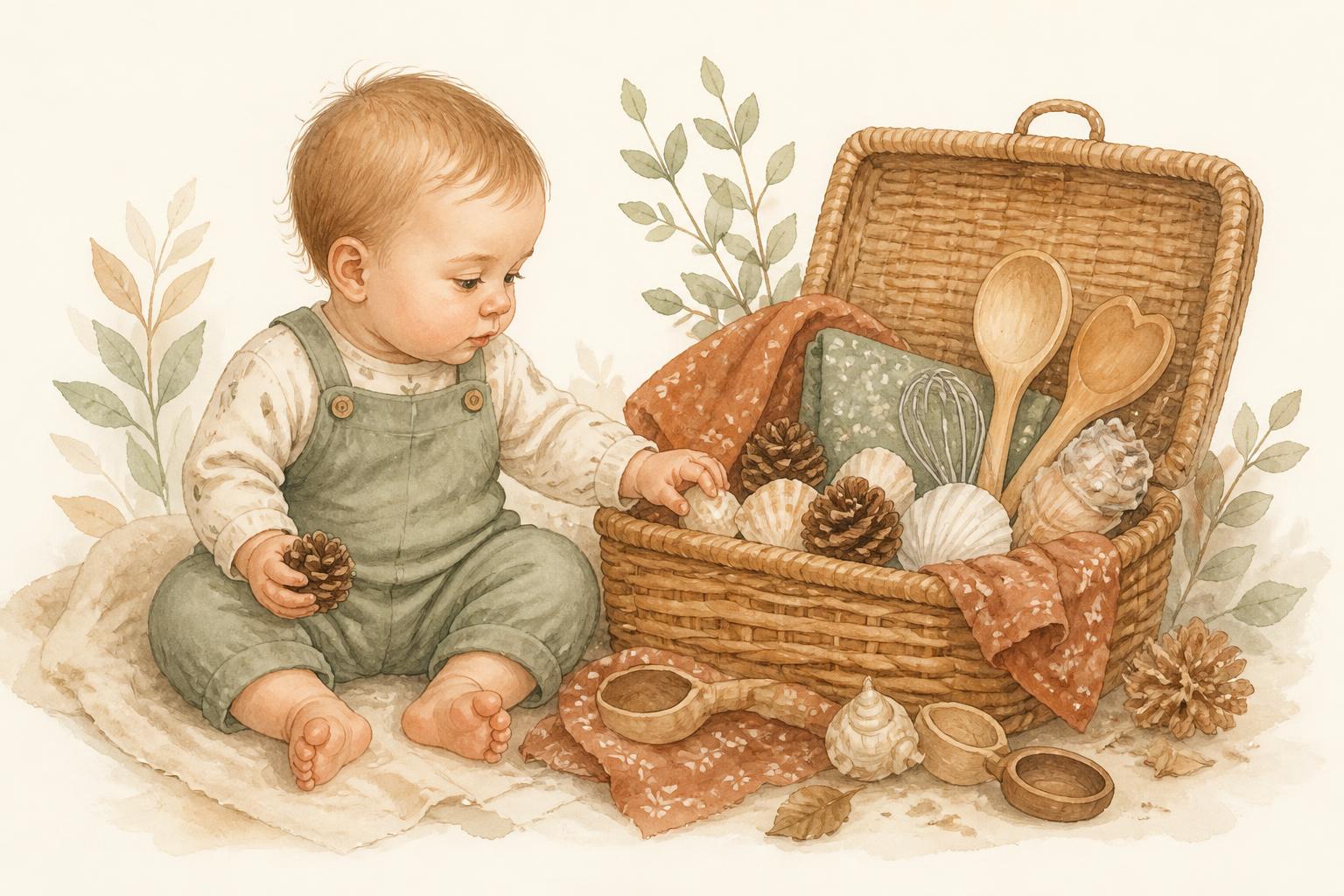
Heuristic play in one paragraph
Heuristic play — from the Greek for 'to discover' — is exploration of everyday objects with no fixed purpose and no adult direction. The child decides what an object is for. The adult's job is to provide, observe and stay out of the way.
It matters because objects with a single function teach a single answer. A whisk, a curtain ring and a tin lid teach hundreds, because the child has to generate the question as well as the answer.
Treasure baskets for babies who can sit
A treasure basket is a sturdy, low, flat-bottomed basket filled with natural and household objects — no plastic and no batteries. The baby sits beside it and chooses freely.
Include a range of materials: wood (spoons, curtain rings, a small brush), metal (whisk, tin lid, measuring spoon, a large key ring), natural (large pinecone, loofah, big shell, pumice), fabric (velvet scrap, ribbon, a knotted cotton napkin), and paper or leather.
Ten to fifteen objects is plenty. Sit nearby, quiet and available, and let them work — babies often stay with a basket far longer than with a toy that does the entertaining for them.
Infographic
Build a treasure basket in five material groups
Ten to fifteen objects, no plastic, no batteries, nothing that entertains for the child.
Wood
Spoons, curtain rings, a small brush, a smooth block.
Metal
Whisk, tin lid, measuring spoon, large key ring — cold, heavy, noisy.
Natural
Large pinecone, big shell, loofah, pumice stone.
Fabric
Velvet scrap, ribbon, knotted cotton napkin, woollen ball.
Paper and leather
Card tube, greaseproof paper, a leather purse or strap.
Check every time
Nothing swallowable, no sharp edges or flaking paint, no long loops. Supervise throughout.
For toddlers, swap to discovery collections: many of one item plus containers to fill, empty and post.
Discovery collections for toddlers
From around a year, children start combining objects rather than just mouthing and examining them — filling, emptying, posting, stacking, lining up.
Offer bags or bins of many of the same item alongside containers: curtain rings and cardboard tubes; jar lids and tins; corks and boxes; pom-poms and cups. Quantity is important — twenty of one thing invites schema play in a way that two does not.
This is also where you see schemas clearly: transporting, enveloping, rotation, trajectory, connection. Naming the schema helps you plan tomorrow's provision.
Safety and hygiene, non-negotiable
Everything must be too large to swallow and free of sharp edges, splinters, flaking paint, small removable parts and loops long enough to wrap around a neck.
Check every item before every session and remove damaged ones. Wash objects regularly — natural items, fabric and metal all need their own routine.
Adults must stay present and attentive throughout. Heuristic play is supervised play, always.
Recording it for Aistear
Heuristic play sits squarely in Aistear's Exploring and Thinking theme, and touches Communicating whenever a child shares a discovery with you.
Keep documentation light: a dated photo, one line on what the child did, one line on what it might mean, and one concrete next step for provision. That is more useful than a full template nobody rereads.
This is exactly the cycle we work through in the 'Open-ended materials' and 'Curriculum planning through emergent interests' sessions, with a booklet and a certificate of attendance for each hour.
Frequently asked questions
- What is heuristic play?
- Heuristic play is free exploration of everyday objects with no fixed purpose and no adult direction. Children decide what the objects are for, while the adult provides, observes and stays out of the way.
- What is a treasure basket?
- A treasure basket is a low, sturdy basket of natural and household objects — wood, metal, natural items, fabric and paper — offered to a baby who can sit unaided, with no plastic or battery-powered toys.
- What age are treasure baskets for?
- Treasure baskets suit babies from the point they can sit unaided. From around a year, most children move on to discovery collections with many of one item plus containers.
- What goes in a treasure basket?
- Ten to fifteen objects across five material groups: wooden spoons and curtain rings, a whisk and tin lid, a pinecone or shell, velvet or ribbon, and a card tube or leather purse.
- Is heuristic play safe for babies?
- Only with constant supervision and careful checking. Every object must be too large to swallow, free of sharp edges, flaking paint and small removable parts, with no long loops, and washed regularly.
- How does heuristic play link to Aistear?
- It sits within Aistear's Exploring and Thinking theme, and supports Communicating when children share discoveries. Document it lightly: a dated photo, what the child did, what it might mean, and the next step for provision.
Keep reading
- BlogThe ECCE scheme explained: free preschool in Ireland, in plain EnglishWhat the ECCE scheme is, what age your child needs to be, how many days it covers and how to apply — plus how to tell whether a preschool is a good fit.Explore
- BlogHow to handle toddler tantrums calmly (without giving in)When tantrums start, why they happen, what to do in the middle of one, and what actually reduces them over time — for 2, 3, 4 and 5 year olds.Explore
- BlogForest school in Ireland: what it is and how to bring it homeWhat forest school means, what happens in a session, what it costs in Ireland, and how to get the same benefits in a local park or back garden.Explore
- BookBook a workshopSee upcoming dates and book onlineExplore
- ContactAsk a questionSend Amy a message about your setting or familyExplore
Bring these ideas into practice
Book a workshop to explore this further with Amy.
Trusted early years resources
Every workshop is grounded in Irish early years frameworks and national guidance.
- Aistear: the Early Childhood Curriculum Framework (NCCA)
- Síolta: the National Quality Framework
- Children First national guidance (Tusla)
- First 5: Ireland's strategy for babies & young children
- Early Childhood Ireland
Workshop themes · Book a date · Counties we serve · Play & learning blog · FAQ · About Amy