
Start with noticing, not fixing
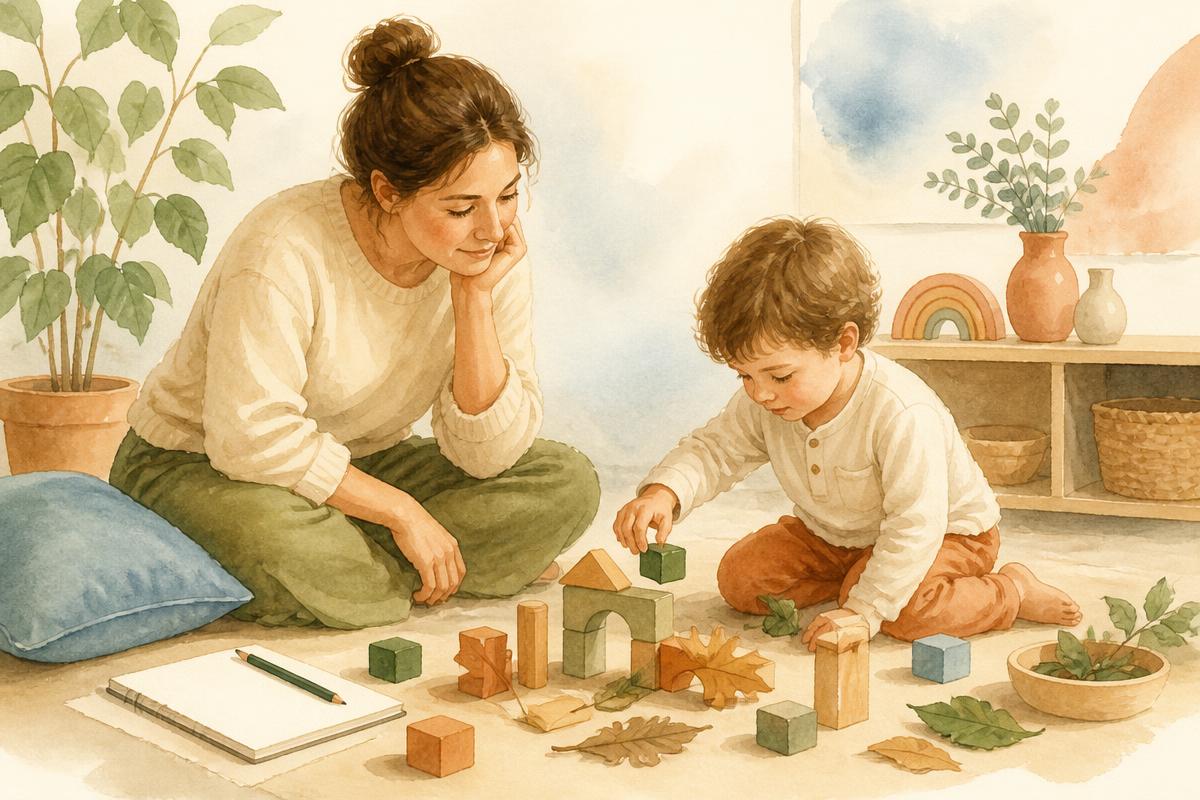
Most emotional development plans fail because they start with the behaviour that bothers the adult most. Amy's approach starts a step earlier: watch first, and write down what you actually see rather than what you assume.
Give it a week. A dated line or two is plenty — what happened just before, what the child did, what helped, how long it took to settle. Patterns show up quickly on paper that are invisible in the middle of a hard morning.
Nine times out of ten the pattern is a time of day, a transition, hunger, tiredness or a moment of too much noise — not a character trait. That matters, because you can change a routine. You cannot change a personality, and you should not try.
Name feelings out loud, in ordinary moments
Children learn emotional language the way they learn every other kind: by hearing it used naturally, long before they can use it themselves. The most useful naming happens when nobody is upset.
Narrate your own: 'I'm a bit frustrated, I'm going to slow down.' Narrate theirs without a verdict: 'That was disappointing.' Skip 'you're fine' — it teaches children to distrust what their body is telling them.
In a setting, this is Aistear's Well-being and Identity and Belonging themes in practice, and it costs nothing but attention. You are building the vocabulary a child will need at five to say 'I need a minute' instead of hitting.
Infographic
A four-week emotional development plan
Amy's approach in five steps — for one child, one month, without turning feelings into paperwork.
Notice for one week
Two dated lines a day: what came before, what happened, what helped.
Name feelings when calm
Narrate your own and theirs in ordinary moments. Never 'you're fine'.
Strengthen one rhythm
Bedtime, arrival, or the move outdoors — dependable for a full month.
Protect open-ended play
Loose parts, water, boxes. Stay near, follow, don't tidy the theme away.
Plan the adult
One slower breath, and a named plan for who steps in when you're spent.
Review after four weeks: shorter, less frequent, or faster to recover all count as progress. Education for adults, not therapy.
Pick one rhythm to strengthen
Emotional regulation is carried by the shape of the day far more than by any single strategy. Choose one rhythm and make it dependable for a month: the wind-down before bed, the arrival routine, the ten minutes after a screen goes off, the transition to outdoors.
Predictability is not rigidity. It means the child knows the order of things, so their energy goes into play instead of bracing for the unknown.
One rhythm, held properly, does more than five new techniques tried once each.
Give play the job of processing
Play is where children rehearse what they cannot yet say. A child who has had a hospital visit will make hospitals out of blocks; a child working out separation will play peekaboo, hide-and-seek and goodbye games for weeks.
Your job is usually to stay near, follow rather than direct, and resist tidying the theme away because it is uncomfortable. Open-ended materials — cloth, boxes, loose parts, water, sand — carry more emotional content than toys with one fixed use.
This is what Amy means by play as a child's first language: not a technique to apply, but the thing you make room for.
Plan the adult, too
Children borrow calm before they can generate it, which means your own regulation is part of the plan rather than a nice extra. One slower breath before you respond, and a realistic look at what your own day is asking of you, changes more than any chart on a wall.
For educators, this is a team conversation: who steps in when a colleague is at the end of their patience, and how the room protects that.
For parents, it is often permission — to do less, to lower the bar for the evening, and to ask for help early rather than at breaking point.
Review it in four weeks, not four days
Look back at your notes after a month and ask three questions: is the hard moment shorter, is it less frequent, and does the child recover with less help than before? Any one of those is progress.
If nothing has shifted at all, change one variable rather than the whole plan — usually the timing, not the technique.
A note on scope: Amy Byrne is an early years educator currently studying a Level 9 postgraduate in play therapy, and is not a qualified play therapist. These workshops are education for adults, not therapy. If you are worried about a child's development or wellbeing, speak to your GP or public health nurse, who can refer on.
Where our workshops fit
The one-hour online session on supporting children's mental health walks through this approach with real examples, and every workshop comes with a booklet to keep. Tickets are €20 online.
If you would rather talk about one particular child, a private 30-minute 1:1 session with Amy is €25 in person — you bring what is going on, and you leave with two or three things to try.
Frequently asked questions
- How do you plan for a child's emotional development?
- Start by observing for a week and writing two dated lines a day about what happens before, during and after hard moments. Then choose one rhythm to strengthen, name feelings in calm moments, protect open-ended play, and review after four weeks rather than four days.
- What age should you start supporting emotional development?
- From birth. Babies regulate by borrowing an adult's calm, and toddlers learn emotional language by hearing it used naturally long before they can use it themselves.
- How do you help a child name their feelings?
- Use feeling words in ordinary, calm moments rather than only mid-meltdown — narrate your own emotions and describe theirs without a verdict. Avoid 'you're fine', which teaches children to distrust what their body is telling them.
- How does play support emotional development?
- Play is where children rehearse experiences they cannot yet put into words. Open-ended materials such as boxes, cloth, water and loose parts carry more emotional content than toys with one fixed use, so stay near, follow the child's theme, and give it time.
- How long before an emotional development plan works?
- Give it about four weeks. Look for hard moments becoming shorter, less frequent, or easier to recover from — any one of those is progress. If nothing shifts, change one variable, usually the timing rather than the technique.
- Is this therapy?
- No. Amy Byrne is an early years educator currently studying a Level 9 postgraduate in play therapy and is not a qualified play therapist. The workshops are education on play-based learning for adults. If you are worried about a child, speak to your GP or public health nurse.
Keep reading
- TopicEmotional regulationWorkshops on emotional regulationExplore
- TopicCurriculum planningWorkshops on curriculum planningExplore
- CourseBig Feelings: Calm Responses to Toddler TantrumsA short, practical course on why tantrums happen, what a child's brain can and cannot do mid-meltdown, and a repeatable way to respond that protects both the limit and the relationship.Explore
- CourseAistear in Practice: Planning from Children's InterestsA plain-English course on Aistear's four themes and how to plan emergent, interest-led experiences without disappearing into paperwork.Explore
- BlogThe ECCE scheme explained: free preschool in Ireland, in plain EnglishWhat the ECCE scheme is, what age your child needs to be, how many days it covers and how to apply — plus how to tell whether a preschool is a good fit.Explore
- BlogHow to handle toddler tantrums calmly (without giving in)When tantrums start, why they happen, what to do in the middle of one, and what actually reduces them over time — for 2, 3, 4 and 5 year olds.Explore
Bring these ideas into practice
Book a workshop to explore this further with Amy.
Trusted early years resources
Every workshop is grounded in Irish early years frameworks and national guidance.
- Aistear: the Early Childhood Curriculum Framework (NCCA)
- Síolta: the National Quality Framework
- Children First national guidance (Tusla)
- First 5: Ireland's strategy for babies & young children
- Early Childhood Ireland
Workshop themes · Book a date · Counties we serve · Play & learning blog · FAQ · About Amy