
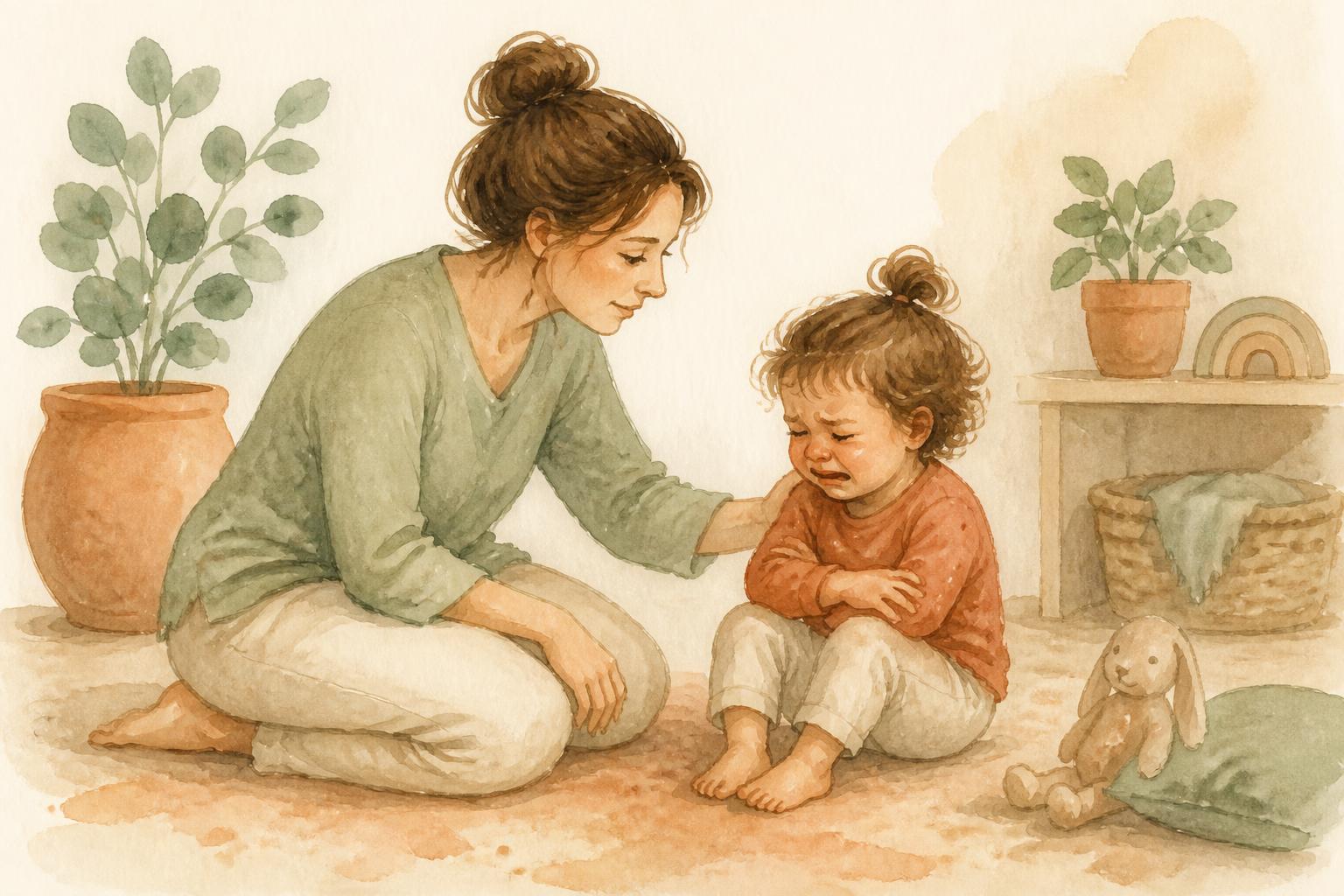
When toddler tantrums start — and why
Most children begin having tantrums somewhere between 18 months and two years, peak in the third year, and taper as language and impulse control grow. Some children still have them at five, and that is within the range of normal.
The timing is not a coincidence. Around two, a child's wants and opinions arrive long before the brain systems that pause, wait, negotiate and find words. The gap between 'I want' and 'I can cope with not getting' is exactly where a tantrum lives.
Tiredness, hunger, too much stimulation, an abrupt transition and a long stretch without connection are the five most reliable triggers. Most 'random' tantrums are one of these five in disguise.
What to do in the middle of one
Lower yourself physically and lower your voice. A child who is flooded cannot process a stream of reasoning — the words simply do not land.
Use fewer words: 'I'm here.' 'That was really hard.' 'I've got you.' Repeat the same short phrase rather than escalating your explanations.
Keep everyone safe, move the child if the setting is unsafe or overwhelming, and then wait. Waiting is the intervention. The wave has to crest before anything else is possible.
Hold the limit while you hold the child. You can be completely warm and still say no. 'You really wanted the sweets. We're not buying them today. I'll stay with you.' Warmth and firmness are not opposites.
Infographic
The five-step calm-down for a tantrum
A sequence you can hold onto when your own patience is thin.
Get low, get quiet
Drop to their height and take your voice down before you say anything.
Fewer words
One short phrase, repeated: 'I'm here. This is hard.'
Safe, then wait
Move them if needed, then let the wave crest. Waiting is the intervention.
Hold the limit warmly
'You really wanted it. Not today. I'll stay with you.' Kind and firm together.
Reconnect, then repair
Comfort first. Talk about it later, briefly, only if it helps.
Prevention beats management: sleep, food, movement, warning before transitions, and real choices inside your limits.
What to skip
Skip 'use your words' mid-storm — the language part of the brain is offline. Skip long explanations, bargaining, and threats you will not follow through on.
Skip the audience management. In a shop, most people either sympathise or forget within a minute; your child will remember how you were with them for far longer.
Skip the post-mortem while they are still raw. Talk about it later, briefly, when everyone is calm — and only if it is genuinely useful.
What reduces tantrums over time
Predictable rhythms. Children fight far fewer battles when the shape of the day is known.
Warnings before transitions. 'Two more slides, then shoes' is not a magic spell, but it halves the ambushes.
Real choice inside your limits: which cup, which jumper, which route home. Autonomy that costs you nothing prevents an enormous number of standoffs.
Daily physical play and outdoor time. Movement is regulation, not a reward for good behaviour.
Your own regulation. Children borrow calm before they can generate it. One slower breath before you respond does more than any chart on the wall.
When to look for more support
If tantrums are extremely frequent or long, involve regular injury, continue intensely well past five, or come with worries about speech, hearing or development, talk to your GP or public health nurse — they can refer on.
A note on scope: Amy Byrne is an early years educator currently studying a Level 9 postgraduate in play therapy, and is not a qualified play therapist. These workshops are education for adults, not therapy.
Frequently asked questions
- When do toddler tantrums start?
- Usually between 18 months and two years. They tend to peak in the third year and reduce as language and impulse control develop, though some children still have them at four or five.
- How do you deal with toddler tantrums?
- Get low, lower your voice, use one short phrase rather than explanations, keep everyone safe and wait for the wave to pass. Hold your limit warmly, then reconnect once the child is calm.
- How do you calm a tantrum quickly?
- There is no reliable quick fix mid-tantrum, because the thinking part of the brain is temporarily offline. The fastest route through is a calm adult, few words and physical safety — plus preventing the common triggers of hunger, tiredness and abrupt transitions.
- How do you deal with 3, 4 and 5 year old tantrums?
- The same principles apply, but older children can handle a short repair conversation later: name what happened, name the feeling, and agree one thing to try next time. Keep it brief and non-shaming.
- Should you ignore tantrums?
- Ignoring the child is different from not negotiating. Stay nearby and available while calmly holding the limit — that teaches a child that big feelings do not drive people away.
- When should I be worried about tantrums?
- Talk to your GP or public health nurse if tantrums are very frequent or prolonged, involve regular injury, continue intensely well past age five, or come alongside concerns about speech, hearing or development.
Keep reading
- TopicEmotional regulationWorkshops on emotional regulationExplore
- TopicBehaviour is communicationWorkshops on behaviour is communicationExplore
- CourseBig Feelings: Calm Responses to Toddler TantrumsA short, practical course on why tantrums happen, what a child's brain can and cannot do mid-meltdown, and a repeatable way to respond that protects both the limit and the relationship.Explore
- BlogThe ECCE scheme explained: free preschool in Ireland, in plain EnglishWhat the ECCE scheme is, what age your child needs to be, how many days it covers and how to apply — plus how to tell whether a preschool is a good fit.Explore
- BlogForest school in Ireland: what it is and how to bring it homeWhat forest school means, what happens in a session, what it costs in Ireland, and how to get the same benefits in a local park or back garden.Explore
- BlogFine motor activities for toddlers using what's already in the pressTwelve no-cost fine motor activities that build the hand strength behind buttons, zips and, eventually, a pencil grip.Explore
Bring these ideas into practice
Book a workshop to explore this further with Amy.
Trusted early years resources
Every workshop is grounded in Irish early years frameworks and national guidance.
- Aistear: the Early Childhood Curriculum Framework (NCCA)
- Síolta: the National Quality Framework
- Children First national guidance (Tusla)
- First 5: Ireland's strategy for babies & young children
- Early Childhood Ireland
Workshop themes · Book a date · Counties we serve · Play & learning blog · FAQ · About Amy